He decided that God’s Word would accompany him on the journey.
There is a silence only a few human beings have ever known.
He decided that God’s Word would accompany him on the journey.
There is a silence only a few human beings have ever known.

Here’s how they stack up:
| Apollo | Artemis | |
| Launch rocket | Saturn V | Space Launch System (SLS) |
| Thrust | 33.8 million newtons | 39.1 million newtons – 15% more than Saturn V |
| Stages | 3 stages | 1.5 stages |
| Crew capsule | Command Module | Orion crew module |
| Crew capacity | 3 astronauts | 4 astronauts |
| Habitable space | 5.95 m³ | 9 m³ |
| Mission duration | Up to 14 days | Up to 21 days |
One of the Artemis II astronauts was carrying something hidden.
Firefly’s Blue Ghost Mission 1, named Ghost Riders in the Sky, launched from pad 39A at NASA’s Kennedy Space Center in Florida, at 1:11 a.m. EST on January 15, 2025. Blue Ghost separated from the SpaceX Falcon 9 rocket in a highly elliptical Earth orbit at 2:17 a.m. EST and established communications with Firefly’s Mission Operations Center in Cedar Park, Texas, at 2:26 a.m. EST.
Blue Ghost Mission 1 will deliver 10 science and technology instruments to the lunar surface as part of NASA’s Commercial Lunar Payload Services (CLPS) initiative. Upon launching on January 15, Blue Ghost is spending approximately 45 days traveling to the Moon, allowing ample time to conduct health checks on each subsystem and begin payload science. Blue Ghost is set to land in Mare Crisium on March 2 and operate payloads for a complete lunar day (about 14 Earth days). On March 14, Firefly expects to capture high-definition imagery of a total eclipse when the Earth blocks the sun above the Moon’s horizon. Blue Ghost will then capture the lunar sunset on March 16, providing data on how lunar dust levitates due to solar influences and creates a lunar horizon glow first documented by Eugene Cernan on Apollo 17. Following sunset, Blue Ghost will operate several hours into the lunar night.


Standing 2 m (6.6 ft) tall and 3.5 m (11.5 ft) wide, Blue Ghost is designed for stability with shock absorbing feet, a low center of mass, and a wide footprint. Blue Ghost’s core components, including the panels, struts, legs, harnesses, avionics, batteries, and thrusters, were built using many of the same flight-proven technologies common to all of Firefly’s launch and orbital vehicles, enabling lower costs and improved reliability.

With just under two hours to go, the Artemis launch crew continued pre-launch preparations including engine number 3 bleed liquid oxygen venting.
Monday, August 29
12 a.m. – Coverage begins for the fueling of the Space Launch System Moon rocket on the Artemis I mission
6:30 a.m. – Artemis I launch coverage begins in English. Launch coverage continues through translunar injection and spacecraft separation, setting Orion on its path to the Moon. (Two-hour launch window opens at 8:33 a.m. EDT)
7:30 a.m. – Launch coverage begins in Spanish on NASA’s Spanish-language social media accounts (Twitter, Facebook, and YouTube) and will continue approximately 15 minutes after lift-off. Mission coverage updates will be posted on the NASA en español social media channels.
12 p.m. – Artemis I post-launch news conference (time subject to change)
This is Live coverage of the fueling of the Space Launch System Moon Rocket for the Artemis I Mission. Continuous coverage of rocket fuelling and the launch of NASA’s new Space Launch System rocket – Artemis – for the first time with an Orion crew capsule that will carry experiments around the moon and back.
The pre-launch preparations can be seen in real time at the NASA live stream website.

In 2019, Australia’s Prime Minister, Scott Morrison announced that $150 million dollars would be set aside as a commitment by Australia to support the planned US mission to Mars.
After attending a State Dinner with US President Trump, Scott Morrison visited Nasa on 20th September 2019 and took the opportunity to make the announcement that the commitment will strengthen the ties between Australian business and NASA.
The investment in Australian business and technology will support NASA’s plans to launch expeditions to both the moon and to Mars.
Mr Morrison said that Australian businesses and researchers have “immense knowledge and capabilities in projects that can support NASA’s Moon to Mars mission, such as Project Artemis and the Lunar Gateway”. He went on to state that… “The Australian Space Agency will work closely with Nasa to identify how they can best support their missions, after the signing of a joint statement of intent on expanding cooperation”.
Australia has a longstanding history of collaboration and support for the United States’ space program.
The partnership between the two countries in space exploration and technology dates back several decades and continues to this day. Here are some key aspects of Australia’s support for the US space program:

Australia provides critical ground stations and tracking facilities that support the communication and tracking of US space missions. The most prominent facility is the Canberra Deep Space Communication Complex (CDSCC), operated by NASA’s Deep Space Network. The CDSCC plays a crucial role in tracking and communicating with various NASA spacecraft, including those exploring the solar system and beyond.
Australia has been involved in launching US satellites and space missions. The Woomera Test Range in South Australia was a key facility used by the United States for missile testing during the Cold War. It has also been utilized for launching sounding rockets and smaller satellites in collaboration with American agencies.
Australia actively contributes to space situational awareness and tracking of space debris. The Australian Space Surveillance and Tracking Centre (ASSTC), located in Western Australia, collaborates with international partners, including the United States, to monitor and track objects in space. This information helps in maintaining the safety and security of space activities.
Australia engages in research and development projects with US space agencies, including NASA. Collaborative efforts involve areas such as space technology, astronomy, astrophysics, and planetary science. These partnerships enhance scientific knowledge, technological advancements, and the exchange of expertise between the two countries.
Australia hosts ground stations for various commercial and military satellite communication systems. These facilities provide support to US satellite operators and contribute to global communication networks.
Australia actively participates in international space programs, including those led by the United States. It collaborates with other countries on space exploration initiatives, such as the International Space Station (ISS) program, where Australian astronauts have participated in missions alongside their American counterparts.
Australia’s support for the US space program is a result of strong bilateral ties, shared values, and mutual interests. The collaboration extends beyond space exploration and encompasses a wide range of areas, including defense, scientific research, and technological innovation.


As the world reflected on the 50th anniversary of the moon landing, in 2019, we were once again setting our sights on our return to the moon, the first time we will have taken that giant leap since the 1969 Apollo 11 mission.


You can watch it live here.

It will be best to view it as it rises over the horizon, to the East-North-East.
The Moon Eclipse should be visible in east Asia, the South Pacific, including most of Australia (not WA) and all of the Americas.
In North America, the partial lunar eclipse should be visible in the early morning, before sunrise, and the Moon will likely have a reddish color.
Here in Queensland Australia, we are expecting to get a good view of the full moon eclipse tonight. The moon rises over Brisbane at 6:15pm, which is just before the sun sets in the west. By 7pm the Moon will be almost entirely eclipsed. But we will still see a small sliver of light on the right-hand side.

Look to the east as the Moon rises. The Moon will be in the constellation of Taurus, the bull. When the moon darkens as it is eclipsed by the Earth, the constellations around it will appear brighter. You may even make out the Seven Sisters, the constellation of Pleiades. The stars will emerge from the darkness just below the almost total lunar eclipse.
High Power Precision Binoculars

This partial lunar eclipse will last for about 3 ½ hours, the longest lunar eclipse duration since the 1400’s.

During a total lunar eclipse, the earth’s shadow falls across the moon’s face as the earth moves between the moon and the sun, and the moon is completely covered by earth shadow. The moon and the sun will then be lining up on exactly opposite sides of our planet.
This will be a total eclipse of the full moon and will also be a Super Moon which is when the moon is at its closest point to the earth. The moon will pass through the earth’s shadow. The earth’s shadow is made up of two cone shaped components. The outer shadow is where the earth blocks part of the sun’s rays while the inner shadow, known as the umbra, is where the earth blocks all direct sunlight from reaching the moon.
According to NASA, if you make a point of watching the event tonight you may be in for a treat. A total eclipse of the moon can often be a beautiful and interesting event. There can be a number of secondary phenomena, especially during the time that the moon is entering and then emerging from the earth shadow. This is why it is called a “Super Flower Blood Moon”.
The blood moon stage will occur at peak totality, which tonight will be at 11:16 GMT.

The total lunar eclipse will be fully visible along the East Coast of Australia. The event will begin at 6:47 PM Brisbane time and reach the maximum eclipse at 9:18 PM Brisbane time. The eclipse will finish at 11:49 PM and the total duration will be 5 hours and two minutes.
Try not to miss this exciting and unique event, being a total eclipse of a supermoon, the first since January 2019.

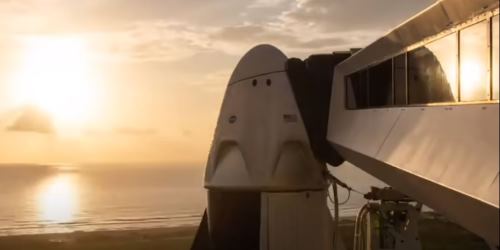
On 30th May 2020, two NASA astronauts climbed inside a Crew Dragon space capsule and launched on top of a Falcon 9 rocket to fly to the International Space Station.

1 They were the first astronauts to launch from American soil in nearly a decade.
2 Commercial companies are now in charge of both the design and production of space vehicles.
The vehicle was commercially made by the company SpaceX and not by NASA. It was the culmination of NASA’s commercial crew program, and the first time a private company has ever launched humans into orbit. Commercial companies are now in charge of both the design and production of space vehicles.
3 But the primary significance of this mission is that the US will no longer have to rely on Russia to get astronauts to and from the International Space Station.
This could be the beginning of a very different era of human spaceflight.
The mission had a very different look from the space flights of the past. SpaceX’s new crew capsule is called the Crew Dragon. It is designed specifically to launch on top of SpaceX’s Falcon 9 rocket. Its chief purpose is to ferry people to and from low earth orbit.

The new capsule is fitted out with life support systems, sleek chairs and shiny touchscreen displays. The astronauts’ custom-designed pressure suits are designed to keep them safe from the harsh environment of space if there is an emergency. The astronauts control the crew dragon through their special touchscreen gloves.

The ISS (International Space Station) docking system, built into the capsule, is entirely automatic. Using a sophisticated system of sensors and cameras, the vehicle can approach the International Space Station completely autonomously, and latch onto an ISS docking port. (In 2019, the SpaceX spaceship, “Crew Dragon” flew unmanned to the International Space Station and docked automatically without any crew on board).

SpaceX can now use the capsule to create a new space tourism business. In fact, the program is intended to kick-start the commercial space flight industry.
First, the two astronauts need to finish their mission. Astronauts Robert Behnken and Douglas Hurley will spend a few weeks on board the International Space Station.

After that, they will climb back into the Crew Dragon and detach themselves from the space station. They will then make the perilous journey back to earth where a suite of parachutes will lower them gently into the ocean. They will then be retrieved by a SpaceX ship.

In the long term, this could become a standard operation for NASA, who are planning for private companies to build and deliver a Moon Lander vehicle onto the Moon.
This could be the beginning of a new space tourism program, commencing as early as 2021.
