Both programs aim to land humans on the Moon, but they’re built for different eras, tech, and goals.
Buzz Aldrin stepping onto the Moon, taken by Neil Armstrong after landing on the moon
Here’s how they stack up:
1. Mission goals & scope
Apollo (1961-1972): A Cold War “space race” to beat the Soviets. Goal was to land a man on the Moon and return him safely, proving U.S. dominance. Missions were short flags-and-footprints trips.
Artemis (2022–present): Designed for long-term, sustainable presence. Goal is to land the first woman and first person of color on the Moon, establish the Gateway lunar space station, and use the Moon as a stepping stone for Mars. Artemis missions are built for longer surface stays and resource exploration.
2. Vehicles & rockets
Apollo
Artemis
Launch rocket
Saturn V
Space Launch System (SLS)
Thrust
33.8 million newtons
39.1 million newtons – 15% more than Saturn V
Stages
3 stages
1.5 stages
Crew capsule
Command Module
Orion crew module
Crew capacity
3 astronauts
4 astronauts
Habitable space
5.95 m³
9 m³
Mission duration
Up to 14 days
Up to 21 days
3. Technology & computers
Apollo: One flight computer, 75% heavier than just one of Orion’s four redundant systems. Had 128,000x less memory and was 20,000x slower. Software only calculated trajectory, no real-time adjustment. Didn’t account for radiation because missions flew during solar minimum.
Artemis/Orion: Four redundant flight computers, modern avionics, and autonomy. Software adjusts trajectory in real-time and automates functions so astronauts can focus on other tasks. Electronics are radiation-hardened.
4. Crew & culture
Apollo: All-male, all-American crews. Launch teams were primarily men.
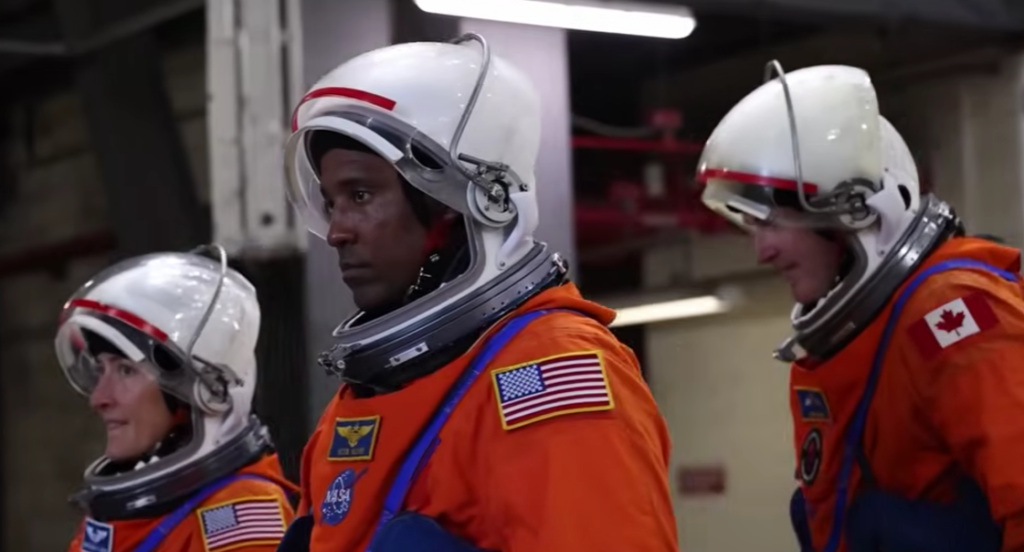
Artemis: Intentionally more representative. Artemis will land the first woman and first person of color. The launch team is now ∼30% women, including the first woman launch director. Artemis II crew includes a woman, person of color, and a Canadian.
5. Lunar operations & science
Apollo: Short stays, up to 12 days. Used the Apollo Lunar Surface Drill and Lunar Roving Vehicle on later J-missions.
Artemis: Designed for longer surface missions. New tech like the TRIDENT drill will sample regolith and hunt for ice/resources to support sustained presence. Gateway station adds an orbital outpost to coordinate vehicles.
6. Pace & approach
Apollo: Went from first U.S. astronaut to Moon landing in 8 years. Very fast, risk-accepting.
Artemis: Much slower after decades of shifting priorities between Moon and Mars. SLS flew uncrewed once in 2022. Artemis II will be the first crewed flight, a lunar flyby like Apollo 8, before a landing on Artemis III or IV.