He decided that God’s Word would accompany him on the journey.
There is a silence only a few human beings have ever known.
He decided that God’s Word would accompany him on the journey.
There is a silence only a few human beings have ever known.

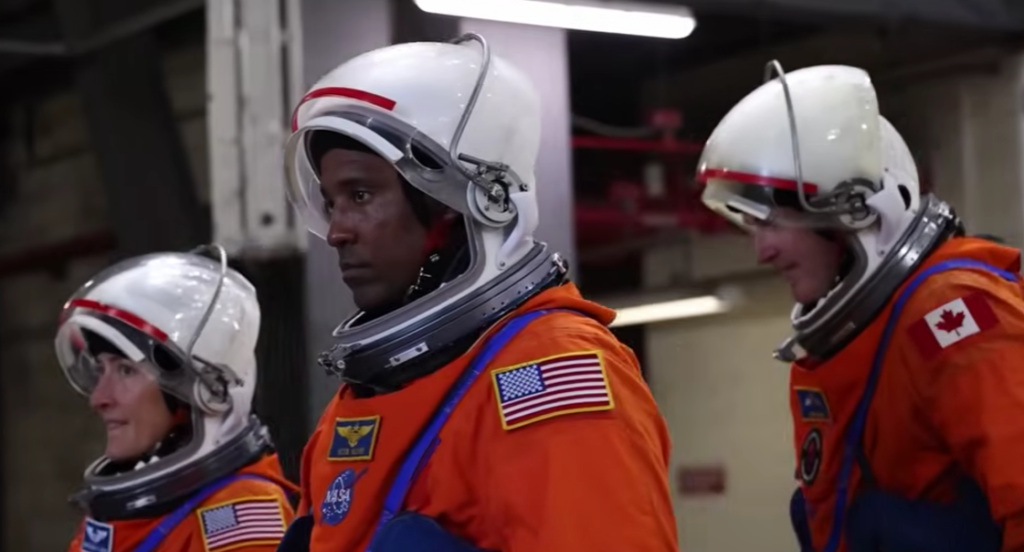
Here’s how they stack up:
| Apollo | Artemis | |
| Launch rocket | Saturn V | Space Launch System (SLS) |
| Thrust | 33.8 million newtons | 39.1 million newtons – 15% more than Saturn V |
| Stages | 3 stages | 1.5 stages |
| Crew capsule | Command Module | Orion crew module |
| Crew capacity | 3 astronauts | 4 astronauts |
| Habitable space | 5.95 m³ | 9 m³ |
| Mission duration | Up to 14 days | Up to 21 days |
One of the Artemis II astronauts was carrying something hidden.
Firefly’s Blue Ghost Mission 1, named Ghost Riders in the Sky, launched from pad 39A at NASA’s Kennedy Space Center in Florida, at 1:11 a.m. EST on January 15, 2025. Blue Ghost separated from the SpaceX Falcon 9 rocket in a highly elliptical Earth orbit at 2:17 a.m. EST and established communications with Firefly’s Mission Operations Center in Cedar Park, Texas, at 2:26 a.m. EST.
Blue Ghost Mission 1 will deliver 10 science and technology instruments to the lunar surface as part of NASA’s Commercial Lunar Payload Services (CLPS) initiative. Upon launching on January 15, Blue Ghost is spending approximately 45 days traveling to the Moon, allowing ample time to conduct health checks on each subsystem and begin payload science. Blue Ghost is set to land in Mare Crisium on March 2 and operate payloads for a complete lunar day (about 14 Earth days). On March 14, Firefly expects to capture high-definition imagery of a total eclipse when the Earth blocks the sun above the Moon’s horizon. Blue Ghost will then capture the lunar sunset on March 16, providing data on how lunar dust levitates due to solar influences and creates a lunar horizon glow first documented by Eugene Cernan on Apollo 17. Following sunset, Blue Ghost will operate several hours into the lunar night.


Standing 2 m (6.6 ft) tall and 3.5 m (11.5 ft) wide, Blue Ghost is designed for stability with shock absorbing feet, a low center of mass, and a wide footprint. Blue Ghost’s core components, including the panels, struts, legs, harnesses, avionics, batteries, and thrusters, were built using many of the same flight-proven technologies common to all of Firefly’s launch and orbital vehicles, enabling lower costs and improved reliability.

You can watch it live here.

It will be best to view it as it rises over the horizon, to the East-North-East.
The Moon Eclipse should be visible in east Asia, the South Pacific, including most of Australia (not WA) and all of the Americas.
In North America, the partial lunar eclipse should be visible in the early morning, before sunrise, and the Moon will likely have a reddish color.
Here in Queensland Australia, we are expecting to get a good view of the full moon eclipse tonight. The moon rises over Brisbane at 6:15pm, which is just before the sun sets in the west. By 7pm the Moon will be almost entirely eclipsed. But we will still see a small sliver of light on the right-hand side.

Look to the east as the Moon rises. The Moon will be in the constellation of Taurus, the bull. When the moon darkens as it is eclipsed by the Earth, the constellations around it will appear brighter. You may even make out the Seven Sisters, the constellation of Pleiades. The stars will emerge from the darkness just below the almost total lunar eclipse.
High Power Precision Binoculars

This partial lunar eclipse will last for about 3 ½ hours, the longest lunar eclipse duration since the 1400’s.