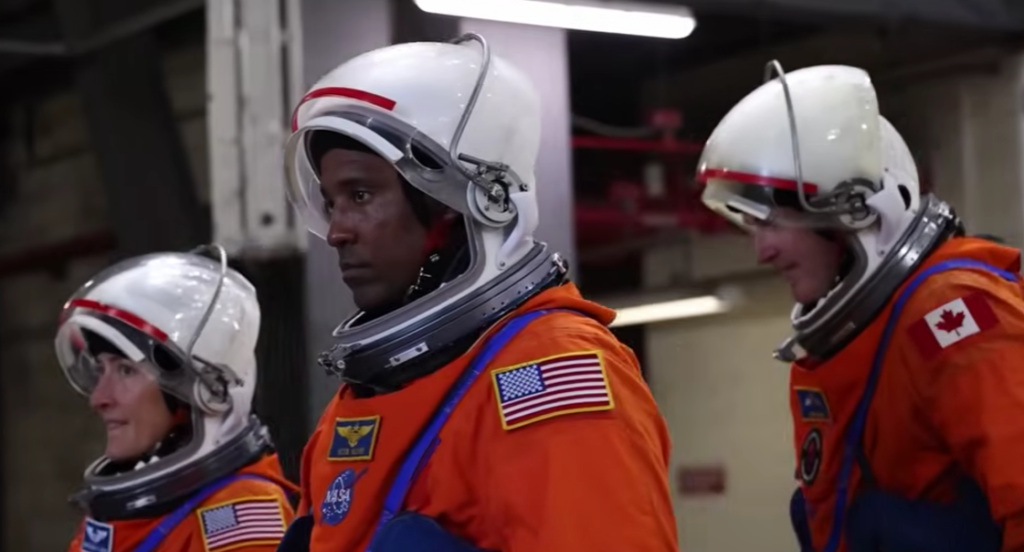
Both programs aim to land humans on the Moon, but they’re built for different eras, tech, and goals.

Here’s how they stack up:
1. Mission goals & scope
- Apollo (1961-1972): A Cold War “space race” to beat the Soviets. Goal was to land a man on the Moon and return him safely, proving U.S. dominance. Missions were short flags-and-footprints trips.
- Artemis (2022–present): Designed for long-term, sustainable presence. Goal is to land the first woman and first person of color on the Moon, establish the Gateway lunar space station, and use the Moon as a stepping stone for Mars. Artemis missions are built for longer surface stays and resource exploration.
2. Vehicles & rockets
| Apollo | Artemis | |
| Launch rocket | Saturn V | Space Launch System (SLS) |
| Thrust | 33.8 million newtons | 39.1 million newtons – 15% more than Saturn V |
| Stages | 3 stages | 1.5 stages |
| Crew capsule | Command Module | Orion crew module |
| Crew capacity | 3 astronauts | 4 astronauts |
| Habitable space | 5.95 m³ | 9 m³ |
| Mission duration | Up to 14 days | Up to 21 days |
3. Technology & computers
- Apollo: One flight computer, 75% heavier than just one of Orion’s four redundant systems. Had 128,000x less memory and was 20,000x slower. Software only calculated trajectory, no real-time adjustment. Didn’t account for radiation because missions flew during solar minimum.
- Artemis/Orion: Four redundant flight computers, modern avionics, and autonomy. Software adjusts trajectory in real-time and automates functions so astronauts can focus on other tasks. Electronics are radiation-hardened.
4. Crew & culture
- Apollo: All-male, all-American crews. Launch teams were primarily men.
- Artemis: Intentionally more representative. Artemis will land the first woman and first person of color. The launch team is now ∼30% women, including the first woman launch director. Artemis II crew includes a woman, person of color, and a Canadian.
5. Lunar operations & science
- Apollo: Short stays, up to 12 days. Used the Apollo Lunar Surface Drill and Lunar Roving Vehicle on later J-missions.
- Artemis: Designed for longer surface missions. New tech like the TRIDENT drill will sample regolith and hunt for ice/resources to support sustained presence. Gateway station adds an orbital outpost to coordinate vehicles.
6. Pace & approach
- Apollo: Went from first U.S. astronaut to Moon landing in 8 years. Very fast, risk-accepting.
- Artemis: Much slower after decades of shifting priorities between Moon and Mars. SLS flew uncrewed once in 2022. Artemis II will be the first crewed flight, a lunar flyby like Apollo 8, before a landing on Artemis III or IV.
One of the Artemis II astronauts was carrying something hidden.