America’s National Aeronautical and Space Administration


As the world reflected on the 50th anniversary of the moon landing, in 2019, we were once again setting our sights on our return to the moon, the first time we will have taken that giant leap since the 1969 Apollo 11 mission.
The images will demonstrate the Webb telescope’s full capabilities. It will soon be ready to reveal infrared images never before seen from the outer universe.

The images will reveal some of the earliest galaxies and stars that formed after the Big Bang, 13.8 billion years ago.
ABC
1080P Wi-Fi Bluetooth Projector
The images will be released one-by-one during a televised broadcast beginning at 10:30 a.m. EDT on Tuesday, July 12, from NASA’s Goddard Space Flight Center in Greenbelt, Maryland.
Live coverage of the image release broadcast will air on NASA TV, the NASA app, and the agency’s website.
The public also can watch live on Facebook, Twitter, YouTube, Twitch, and Daily Motion.

You can watch it live here.

It will be best to view it as it rises over the horizon, to the East-North-East.
The Moon Eclipse should be visible in east Asia, the South Pacific, including most of Australia (not WA) and all of the Americas.
In North America, the partial lunar eclipse should be visible in the early morning, before sunrise, and the Moon will likely have a reddish color.
Here in Queensland Australia, we are expecting to get a good view of the full moon eclipse tonight. The moon rises over Brisbane at 6:15pm, which is just before the sun sets in the west. By 7pm the Moon will be almost entirely eclipsed. But we will still see a small sliver of light on the right-hand side.

Look to the east as the Moon rises. The Moon will be in the constellation of Taurus, the bull. When the moon darkens as it is eclipsed by the Earth, the constellations around it will appear brighter. You may even make out the Seven Sisters, the constellation of Pleiades. The stars will emerge from the darkness just below the almost total lunar eclipse.
High Power Precision Binoculars

This partial lunar eclipse will last for about 3 ½ hours, the longest lunar eclipse duration since the 1400’s.

During a total lunar eclipse, the earth’s shadow falls across the moon’s face as the earth moves between the moon and the sun, and the moon is completely covered by earth shadow. The moon and the sun will then be lining up on exactly opposite sides of our planet.

This will be a total eclipse of the full moon and will also be a Super Moon which is when the moon is at its closest point to the earth. The moon will pass through the earth’s shadow. The earth’s shadow is made up of two cone shaped components. The outer shadow is where the earth blocks part of the sun’s rays while the inner shadow, known as the umbra, is where the earth blocks all direct sunlight from reaching the moon.
According to NASA, if you make a point of watching the event tonight you may be in for a treat. A total eclipse of the moon can often be a beautiful and interesting event. There can be a number of secondary phenomena, especially during the time that the moon is entering and then emerging from the earth shadow. This is why it is called a “Super Flower Blood Moon”.
The blood moon stage will occur at peak totality, which tonight will be at 11:16 GMT.

The total lunar eclipse will be fully visible along the East Coast of Australia. The event will begin at 6:47 PM Brisbane time and reach the maximum eclipse at 9:18 PM Brisbane time. The eclipse will finish at 11:49 PM and the total duration will be 5 hours and two minutes.
Try not to miss this exciting and unique event, being a total eclipse of a supermoon, the first since January 2019.


NASA’s Perseverance rover is about to guide itself to the surface of Mars in the most precise landing operation yet undertaken.
Every process must take place without error and precisely on time, in order for the landing to succeed.
The descent is scheduled to take place today on the 18th February 2021 at 3:55 pm American Eastern Standard Time.
Perseverance will be the fifth rover to land on the red planet. The spacecraft is on target to touch down in Jezero Crater. It’s mission will be to scientifically discover whether there were ever any lifeforms on the surface of Mars.
“Jezero Crater is the most challenging Martian terrain ever targeted for a landing”.
Thomas Zurbuchen, associate administrator for the Science Mission Directorate at NASA Headquarters
It’s landing day for Perseverance and all eyes are on the Red Planet.
The rover spent the last seven months flying the roughly 125-million-mile (202 million kilometers) distance to Mars on a quest to find signs of ancient life. Later today (Feb. 18), the mission will begin a daring “seven minutes of terror“-type descent, and if all goes well, its wheel touchdown will signal the beginning of the most powerful rover yet to roam the Martian surface.
Perseverance will broadcast information back in high-definition 4K, set aside promising rock samples for a sample-return mission and launch the first interplanetary helicopter — all the while photographing, laser-targeting and investigating targets in the ancient delta of Jezero Crater.

Jupiter and Saturn have been travelling across the sky together this month but right now they are really putting on a show. You can see them in the western sky, very low, each evening for an hour after sunset. A conjunction will occur every 20 years this century but this one is called a “great conjunction”.
On 21st December 2020, the two planets were approximately 1/10 of a degree apart. They will not appear this close in the sky again until the year 2080.

The last time that these two planets were visible across the earth was on 5th March in the year 1226, when they were even closer compared to what we will see this year.
If you have binoculars or a small telescope you will be able to see both Jupiter and Saturn along with Jupiter’s moons.

If you would like to see the moons of Jupiter, train your telescope on Jupiter that night, and if there are no clouds, three of the four famous Galilean satellites will be visible. The moons of Jupiter that will be visible are Callisto, Io and Europa.
On one side of Jupiter, you’ll see its volcanic moon, Io (closest to Jupiter’s disk) and second-largest moon, Callisto. On the other side of Jupiter will be Ganymede, Jupiter’s largest moon. As for Europa, it will be in transit, crossing in front of Jupiter, so cannot be seen.

This could be a “once in a lifetime opportunity” to see the Great Conjunction of the planets Saturn and Jupiter. The planets will be visible until the end of January 2021.

In this photo, taken with a cell phone in Australia, the two planets can be clearly seen

A new Mars Rover named Perseverance will land on the surface of Mars in February 2221, after a seven-month flight through space.
Attached to the underbelly of the space craft will be a small helicopter named Ingenuity. Ingenuity will be able to overcome Mars gravity and fly over the surface of Mars like a drone and return visual images. This will be the first test of powered flight on Mars.
The purpose of the mission will be to investigate key questions about the possible existence of life on Mars. Perseverance will examine the past Martian environment and look for signs of ancient microbes amongst the intriguing rocks of a crater named Jezero.
The robotic machine will drill into the rocks and collect soil samples using new technology. After examining the samples, it will set them aside so that a future mission will be able to bring them back to Earth.
All Earthlings interested in Mars and Martians are invited by NASA to virtually watch the Launch of Perseverance – Click HERE to register.
The Mars 2020 launch event will commence at 7:50am on Thu, 30 Jul 2020 US EDT. [Thu, Jul 30, 2020, 9:50 PM AEST in Australia]

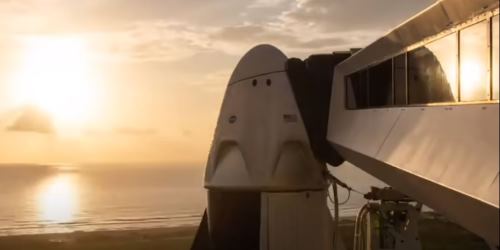
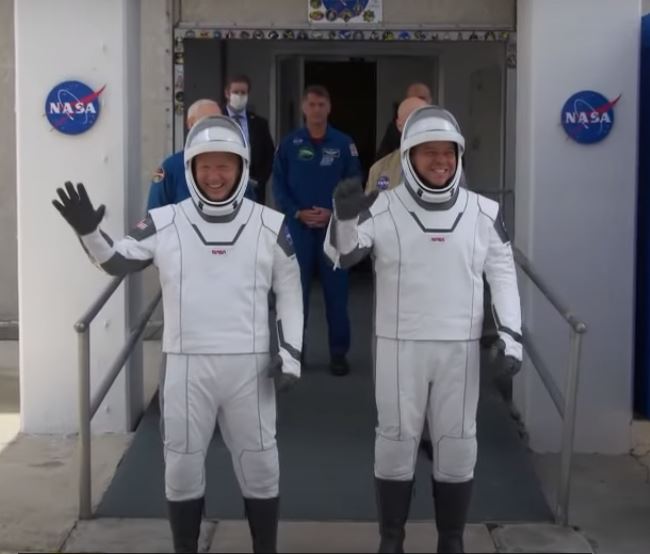
On 30th May 2020, two NASA astronauts climbed inside a Crew Dragon space capsule and launched on top of a Falcon 9 rocket to fly to the International Space Station.

1 They were the first astronauts to launch from American soil in nearly a decade.
2 Commercial companies are now in charge of both the design and production of space vehicles.
The vehicle was commercially made by the company SpaceX and not by NASA. It was the culmination of NASA’s commercial crew program, and the first time a private company has ever launched humans into orbit. Commercial companies are now in charge of both the design and production of space vehicles.

3 But the primary significance of this mission is that the US will no longer have to rely on Russia to get astronauts to and from the International Space Station.
This could be the beginning of a very different era of human spaceflight.
The mission had a very different look from the space flights of the past. SpaceX’s new crew capsule is called the Crew Dragon. It is designed specifically to launch on top of SpaceX’s Falcon 9 rocket. Its chief purpose is to ferry people to and from low earth orbit.

The new capsule is fitted out with life support systems, sleek chairs and shiny touchscreen displays. The astronauts’ custom-designed pressure suits are designed to keep them safe from the harsh environment of space if there is an emergency. The astronauts control the crew dragon through their special touchscreen gloves.

The ISS (International Space Station) docking system, built into the capsule, is entirely automatic. Using a sophisticated system of sensors and cameras, the vehicle can approach the International Space Station completely autonomously, and latch onto an ISS docking port. (In 2019, the SpaceX spaceship, “Crew Dragon” flew unmanned to the International Space Station and docked automatically without any crew on board).

SpaceX can now use the capsule to create a new space tourism business. In fact, the program is intended to kick-start the commercial space flight industry.
First, the two astronauts need to finish their mission. Astronauts Robert Behnken and Douglas Hurley will spend a few weeks on board the International Space Station.

After that, they will climb back into the Crew Dragon and detach themselves from the space station. They will then make the perilous journey back to earth where a suite of parachutes will lower them gently into the ocean. They will then be retrieved by a SpaceX ship.

In the long term, this could become a standard operation for NASA, who are planning for private companies to build and deliver a Moon Lander vehicle onto the Moon.
This could be the beginning of a new space tourism program, commencing as early as 2021.


The SpaceX launch today, known as Demo-2, will once again permit the US to send humans into space. Astronauts Robert Behnken and Douglas Hurley will take off for the International Space Station at 3:22 p.m. EDT May 30, from Launch Complex 39A in Florida. The SpaceX launch can be viewed live on NASA-TV.

The rocket launch today will lay the groundwork for future exploration of the Moon and Mars, starting with NASA’s Artemis program, which aims to land the first woman and the next man on the lunar surface in 2024.
According to NASA, the Demo-2 mission is intended to demonstrate the ability of SpaceX to ferry astronauts to the International Space Station and back safely. The aim is to get the “Crew Dragon” astronaut carrier certified for more long-term manned missions into space.

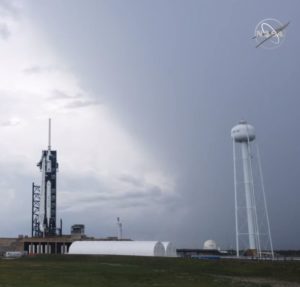
The SpaceX rocket will lift off from the Florida launchpad 39A and two astronauts will be aboard the specially instrumented Falcon 9 rocket. The rocket launch will be the second attempt, as the first attempt was aborted due to a potential lightning strike.
The two astronauts, after docking with the International Space Station, will join the crew on the space station. NASA news of the SpaceX launch can be followed on the NASA website. After launch, the SpaceX mission will be monitored and controlled from the Johnson Space Centre in Houston Texas.
The spacecraft has been built by the SpaceX company owned by billionaire entrepreneur Elon Musk. The rocket launch today will be the first time that such a mission has been attempted by a privately owned company.
The journey to space will take around 10 minutes. After about two minutes, the rocket will separate into a first-stage and a second-stage. The first stage will return to a SpaceX landing ship in the Atlantic Ocean whilst the second stage will continue the journey with the Crew Dragon capsule on board.
The capsule will then separate from the second-stage and travel at 17,000 mph before being in position to rendezvous and dock with the Space Station, 24 hours later.
On conclusion of the mission, Crew Dragon will autonomously undock with the two astronauts on board, leave the space station and re-enter the Earth’s atmosphere. Upon splashdown just off Florida’s Atlantic Coast, the crew will then be picked up at sea by SpaceX’s Go Navigator recovery vessel and return to Cape Canaveral.

The Demo-2 mission will be the final major step before NASA’s Commercial Crew Program certifies Crew Dragon for operational, long-duration missions to the Space Station.
This certification and regular operation of Crew Dragon will enable NASA to continue the important research and technology investigations taking place on board the station.